Vision Language Navigation Explained: How Robots Follow Directions, with Python Code
Vision language navigation explained: how robots follow directions, what SR and SPL mean, and how ZeroVLN skips fine tuning, with Python code.
Tell a friend "go down the hall, past the bathroom, and wait by the second door on the left," and they will find it in a house they have never visited. Ask a robot to do the same and you are asking it to solve one of the oldest open problems in embodied AI: vision language navigation, or VLN.
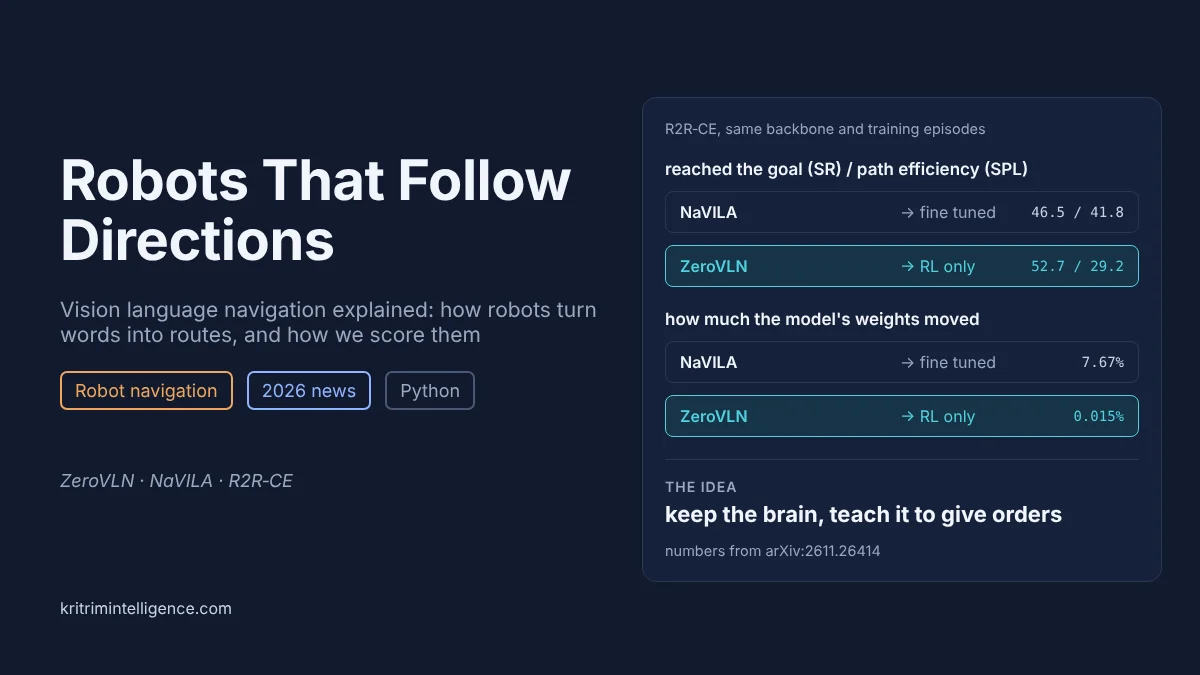
On November 19, 2026, a team posted ZeroVLN, which takes an unusual route. Most recent systems retrain a large vision language model to output navigation goals. ZeroVLN leaves that model almost untouched and instead teaches it, with reinforcement learning, to give orders in plain words to a separate motion model. On the standard R2R-CE benchmark it reached the goal more often than NaVILA, a well known baseline, while changing the model's weights by only 0.015%.
But it scored lower on path efficiency. This post explains what VLN is, how it is scored, why that trade off matters, and what ZeroVLN changes. A short Python example shows how a robot can raise its success rate while its efficiency score falls behind.
What this guide covers
- Vision language navigation at a glance
- What is vision language navigation?
- How VLN is scored: SR, SPL and OSR
- How robots learned to follow directions
- The hidden cost of fine tuning
- ZeroVLN: keep the brain, train the conversation
- A Python example: success vs efficiency
- What still holds VLN back
- Frequently asked questions
- Closing thoughts
Vision language navigation at a glance
| The task | Follow directions in plain language through a building the robot has never seen |
| The classic benchmark | Room-to-Room (R2R), 2018, and its continuous version VLN-CE, 2020 |
| How it is scored | SR (did it stop near the goal), SPL (how efficient was the path), OSR (did it ever pass the goal) |
| In the news | ZeroVLN (November 19, 2026): no supervised fine tuning of the planner, trained with reinforcement learning |
| The headline numbers | R2R-CE: ZeroVLN SR 52.7%, SPL 29.2%; NaVILA SR 46.5%, SPL 41.8% |
| Why it matters | ZeroVLN moved the model's weights by 0.015% against 7.67% for NaVILA |
| Our Python result | Searching more raises SR from 46% to 83%, but the gap between SR and SPL grows from 8 to 30 points |
What is vision language navigation?
In vision language navigation, a robot starts somewhere in a building it has never seen and gets an instruction such as "exit the bedroom, go down the stairs and stop next to the piano." It sees only through its own camera. There is no map with the piano marked on it. The robot has to link each phrase to what it sees, keep track of how far through the instruction it is, and decide when it has arrived.
This is harder than it sounds. Instructions are vague ("the second door"), the same word can mean different things in different houses, and a small wrong turn early on can send the robot to the wrong room. It is different from point to point planning with A* or Dijkstra, where the goal's position is known. In VLN, finding the goal is half the job.
The field took off with Room-to-Room (R2R) in 2018: 21,567 English instructions for routes through 90 real buildings scanned in 3D. In that first version, the robot jumped between fixed viewpoints on a graph. VLN-CE, from 2020, dropped the graph. The robot moves with small steps through continuous 3D scans, much like a real robot would. Most modern results, including ZeroVLN's, are reported on R2R-CE and its multilingual sibling RxR-CE.
How VLN is scored: SR, SPL and OSR
Three numbers come up in almost every VLN paper, and reading them together matters.
- SR, success rate. The share of runs where the robot stops within 3 metres of the goal. Passing by is not enough. It has to decide it has arrived.
- OSR, oracle success rate. The share of runs where the robot came within 3 metres of the goal at any point, even if it then walked away. The gap between OSR and SR shows how often the robot found the goal but failed to recognize it.
- SPL, success weighted by path length. Proposed in 2018 for exactly this reason. For each successful run, it divides the shortest possible path by the path the robot took (capped at 1). A robot that succeeds by walking twice as far as needed gets half credit.
SPL can never be higher than SR. The gap between them tells you how much the robot wandered on the runs it got right. A small gap means it mostly walked straight to the goal. A large one means it searched.
How robots learned to follow directions
Early VLN systems were trained from scratch on R2R and generalized poorly to new buildings. The big change came with large vision language models (VLMs), which already know what a piano, a staircase and a hallway look like. Recent systems use a VLM as the robot's "brain" and fine tune it on navigation data to output goals or short movements.
NaVILA, from 2024, is a well known example. It fine tunes a VLM to give mid level actions in language, such as "move forward 75 cm" or "turn left 30 degrees", and a separate learned controller turns those into leg motions. That split let it run on real legged robots, including a four legged robot dog and a humanoid. Many 2025 and 2026 systems follow the same slow planner, fast controller pattern, which we touched on in our post on agentic robotics.
The hidden cost of fine tuning
Fine tuning a VLM on navigation data teaches it to find its way. But it changes the model's weights, and the same weights hold everything else the model knew: reading signs, counting objects, answering questions about a scene. Push them hard toward one task and the others can get worse. Researchers call this catastrophic forgetting.
For a robot that only moves around, that might not matter. For a home robot that should find the kitchen, then answer "is the stove still on?", it does. The ZeroVLN team measured how far each method moved the brain's weights:
| Method | Relative change in the VLM's weights |
|---|---|
| NaVILA | 7.67% |
| DualVLN | 3.21% |
| ZeroVLN | 0.015% |
Across twelve general visual and spatial tests, ZeroVLN's brain averaged 59.16%, against 59.47% for the original model before any training. The authors are careful to call this close, not identical.
ZeroVLN: keep the brain, train the conversation
ZeroVLN keeps the slow brain, fast controller split, but changes what passes between them and how they learn.
- The brain gives orders in words. Instead of predicting coordinates, the VLM (Qwen3.6-35B-A3B in the main comparison) makes a tool call: a target, where the target is relative to the robot, and a short local plan. It can turn to look around or decide to stop.
- An action expert carries them out. A separate model takes the order and the camera view, predicts 16 small movements, runs the first four and then checks back with the brain.
- Stage 1 teaches only the action expert. The brain is frozen. A planner with access to the building's map, which is only available during training, turns each of the brain's orders into a reachable goal and a reference path. The expert learns to follow them.
- Stage 2 trains both together with reinforcement learning. The robot runs full episodes in simulation. Rewards come for getting closer to the goal, for discovering new things, for first arriving and for finishing. Both models share one score for the whole run, so each learns how its part affected the result. The paper does not name its exact algorithm, but scoring whole runs is the same idea behind GRPO.
Since the brain only ever learned to speak to the action expert, never to output navigation coordinates, its weights barely move.
The results
In a controlled test, with the same backbone and the same 34,445 training episodes on R2R-CE:
| Method | SR | OSR | SPL |
|---|---|---|---|
| ZeroVLN | 52.7% | 66.7% | 29.2% |
| NaVILA | 46.5% | 51.8% | 41.8% |
ZeroVLN reaches the goal more often and passes near it far more often. But its SPL is 12.6 points lower, which means its successful runs take much longer paths. The authors state this openly as a limitation. All results are in simulation, and none on a real robot.
A Python example: success vs efficiency
Why would a method reach the goal more often but score lower on efficiency? The simplest answer is search: a robot that looks around and checks a few more places before stopping will find the goal more often, at the cost of walking further. Our simulation shows how that plays out in the numbers.
A robot is told to reach a goal 5 to 20 metres away. Its model guesses where the goal is, with an error that grows with distance, as vague directions do. The robot walks to its guess and looks around. If it spots the goal within 4 metres (80% of the time when it is there), it walks over and stops. If not, it checks up to a set number of extra spots on a circle around its guess. We measure SR, OSR and SPL exactly as VLN papers do.
import numpy as np

# A robot hears "go to the kitchen door" and has to find it.
# Its model guesses where the door is, with an error that grows with distance.
# The standard VLN scores:
#   SR  : success rate, the robot STOPS within 3 m of the goal
#   OSR : oracle success, it passed within 3 m at some point
#   SPL : success weighted by path length = S * shortest / max(path, shortest)
R_OK, R_SEE = 3.0, 4.0        # success radius, how close it must be to spot the goal


def walk(path):
    """total length of a path, and points along it every 0.25 m"""
    pts, total = [path[0]], 0.0
    for a, b in zip(path[:-1], path[1:]):
        seg = np.linalg.norm(b - a)
        total += seg
        n = max(1, int(seg / 0.25))
        pts += [a + (b - a) * k / n for k in range(1, n + 1)]
    return total, np.array(pts)


def episode(spots, rng):
    """spots = how many extra places the robot checks before giving up"""
    d = rng.uniform(5, 20)                      # shortest distance to the goal
    ang = rng.uniform(0, 2 * np.pi)
    goal = d * np.array([np.cos(ang), np.sin(ang)])
    guess = goal + rng.normal(0, 0.3 * d, 2)    # the model's guess
    ring = [guess + 4 * np.array([np.cos(t), np.sin(t)])
            for t in np.linspace(0, 2 * np.pi, 8, endpoint=False)]
    path = [np.zeros(2)]
    for p in [guess] + ring[:spots]:
        path.append(p)
        if np.linalg.norm(goal - p) < R_SEE and rng.random() < 0.8:
            path.append(goal + rng.normal(0, 0.5, 2))   # spotted it: walk over
            break
    length, pts = walk(path)
    success = np.linalg.norm(path[-1] - goal) < R_OK
    oracle = (np.linalg.norm(pts - goal, axis=1) < R_OK).any()
    spl = success * d / max(length, d)
    return success, oracle, spl, length / d


rng = np.random.default_rng(0)
print(f"{'extra spots checked':>20} {'SR':>6} {'OSR':>6} {'SPL':>6} {'SR - SPL':>9} {'path / shortest':>16}")
for spots in [0, 2, 4, 8]:
    r = np.array([episode(spots, rng) for _ in range(20000)])
    sr, osr, spl, ratio = r.mean(axis=0)
    print(f"{spots:>20} {sr:>6.1%} {osr:>6.1%} {spl:>6.1%} {sr - spl:>9.1%} {ratio:>15.2f}x")
Running it prints:
 extra spots checked     SR    OSR    SPL  SR - SPL  path / shortest
                   0  46.3%  59.4%  38.3%      8.0%            1.15x
                   2  56.1%  69.7%  42.1%     14.0%            1.50x
                   4  66.9%  76.3%  46.9%     19.9%            1.72x
                   8  82.7%  86.6%  52.6%     30.1%            1.99x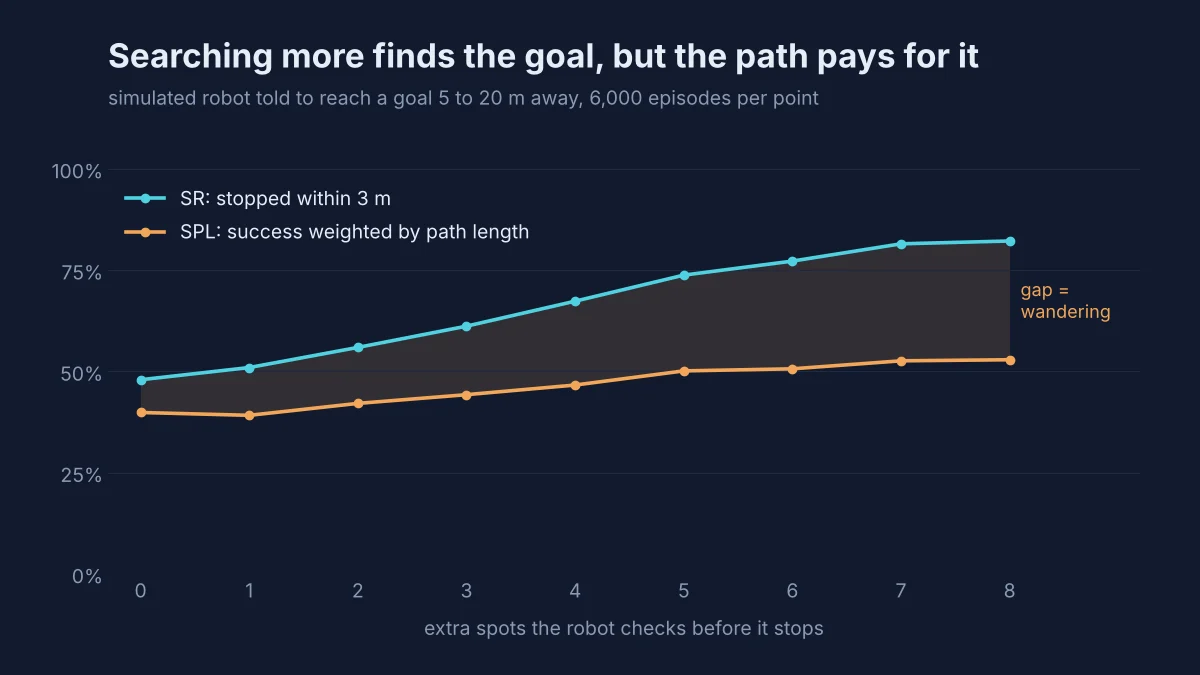
Searching raises success. With no extra search, the robot stops at the goal 46.3% of the time, close to NaVILA's 46.5%. Checking 8 extra spots lifts that to 82.7%.
Efficiency rises much less. SPL only climbs from 38.3% to 52.6%, since every successful search adds walking. The average path grows from 1.15 to 1.99 times the shortest route.
The gap tells the story. The distance between SR and SPL grows from 8 points to 30. ZeroVLN's gap is 23.5 points, NaVILA's 4.7. Reading SR alone, ZeroVLN looks clearly better. Reading SPL alone, NaVILA does. Reading both shows two different styles: one goes straight and is often wrong, the other searches and is often right.
This is a toy on an open floor with no walls. Real buildings make search more costly and wrong guesses harder to fix. And we do not know that search is the full reason for ZeroVLN's longer paths. But it shows why VLN papers report SR and SPL side by side, and why neither number means much alone.
What still holds VLN back
- Simulation to reality. ZeroVLN, like most VLN work, is tested only in 3D scans. Real robots face moving people, closed doors and changing light.
- Training still uses privileged maps. ZeroVLN's first stage depends on a map and geometry that a real robot would not have.
- Efficiency. A robot that wanders is slow and drains its battery. ZeroVLN's lower SPL is a real cost, not just a number.
- Speed. Large VLM brains are slow to answer, the same latency problem we covered for robot arms.
- Knowing where you are. Many failures come from losing track of position. Pairing VLN with good mapping, such as visual SLAM, is an active area, and the same need shows up in drones flying without GPS.
Frequently asked questions
What is vision language navigation (VLN)?
Vision language navigation is the task of a robot following spoken or written directions through a place it has never seen, such as "walk past the sofa, turn left and stop at the kitchen door." The robot sees only through its own camera and must link the words to what it sees as it moves.
What do SR and SPL mean in VLN?
SR, the success rate, is the share of runs where the robot stops within 3 metres of the goal. SPL, success weighted by path length, gives a successful run full credit only if its path was as short as the best possible path, and less credit the longer it wandered. SPL can never be higher than SR.
What is VLN-CE?
VLN-CE, short for VLN in continuous environments, is a 2020 version of the classic Room-to-Room benchmark. In the original, the robot jumped between fixed points on a map. In VLN-CE it moves with small, low level steps through 3D scans of real homes, which is much closer to driving a real robot.
What is ZeroVLN?
ZeroVLN is a navigation method posted on November 19, 2026. A general vision language model plans the route and gives orders in plain words to a separate action model that moves the robot. Both are trained together with reinforcement learning, with no supervised fine tuning of the planner on navigation data.
Why not just fine tune a vision language model for navigation?
Fine tuning works, but it changes the model's weights and can make it worse at everything else it knew. In the ZeroVLN paper, a fine tuned method moved the model's weights by 7.67%, while ZeroVLN moved them by 0.015% and kept its general visual skills almost unchanged.
Closing thoughts
Vision language navigation has moved from small models trained on one dataset to large general models adapted to move. ZeroVLN asks a sensible question about that move: if the general model is the valuable part, why rewrite it? Teaching it to give orders, and letting reinforcement learning tune the conversation, reached the goal more often while leaving the model almost as it was.
The price showed up in SPL, which is exactly why that number exists. The next step is a robot that searches when it is unsure and walks straight when it is not, and that keeps both numbers high.
If you run the example, try making the robot better at spotting the goal, or smarter about where it searches first, and watch whether SPL can catch up with SR. We would like to hear what you find.
References
- Z. Huang, Y. Zhou and others, ZeroVLN: Learning to Navigate without Supervised Fine-Tuning of the VLM Brain, November 2026. arXiv:2611.26414
- A.-C. Cheng and others, NaVILA: Legged Robot Vision-Language-Action Model for Navigation, 2024. arXiv:2412.04453
- P. Anderson and others, Vision-and-Language Navigation: Interpreting visually-grounded navigation instructions in real environments, 2018. arXiv:1711.07280
- J. Krantz and others, Beyond the Nav-Graph: Vision-and-Language Navigation in Continuous Environments, 2020. arXiv:2004.02857
- P. Anderson and others, On Evaluation of Embodied Navigation Agents, 2018. arXiv:1807.06757
- Hugging Face, trending papers, November 2026. huggingface.co