Voice Controlled Drone Swarms Explained: Speech, Small Language Models and Safety, with Python Code
Voice controlled drone swarms explained: how speech becomes swarm tasks, why small language models help, and how to stop misheard commands, with Python.
"Drone four, zoom in on the red truck. Team B, survey the north field. Everyone else, return to base." A person can say that in five seconds. Typing it into a ground station, drone by drone, takes much longer, and in the field the operator's hands and eyes are often busy with something else.
That is the promise of voice controlled drone swarms, and it is the topic of our next research project at Kritrim Intelligence. This post is the survey we wrote to start it. It builds on our work with Veg, our quadcopter that flies without GPS, and on TFuzzyScore, our paper on matching noisy text to known names, which turns out to be exactly the problem at the heart of voice command.
The timing is good. On November 13, 2026, a team at Mälardalen University in Sweden posted a careful study of dependable voice command for multi drone swarms using a small language model. It shows both how much a language model can fix and how far the field still has to go. A short Python example then looks at the most practical question in the design: when should the swarm act, and when should it ask?
What this guide covers
- Voice swarm control at a glance
- Why talk to a swarm?
- The six layers of a voice controlled swarm
- Speech recognition is the weak link
- Dependable voice command with a small language model
- From words to swarm behavior: SkySim and CommandSwarm
- A Python example: when should the swarm ask?
- Open problems
- Frequently asked questions
- Closing thoughts
Voice swarm control at a glance
| The idea | An operator speaks; speech recognition, a language model and a planner turn the words into tasks for many drones |
| The weak link | Speech recognition in noise: drone names and short command words are easy to mishear |
| In the news | Dependable voice command for multi drone swarms using small language models (Mälardalen University, November 13, 2026) |
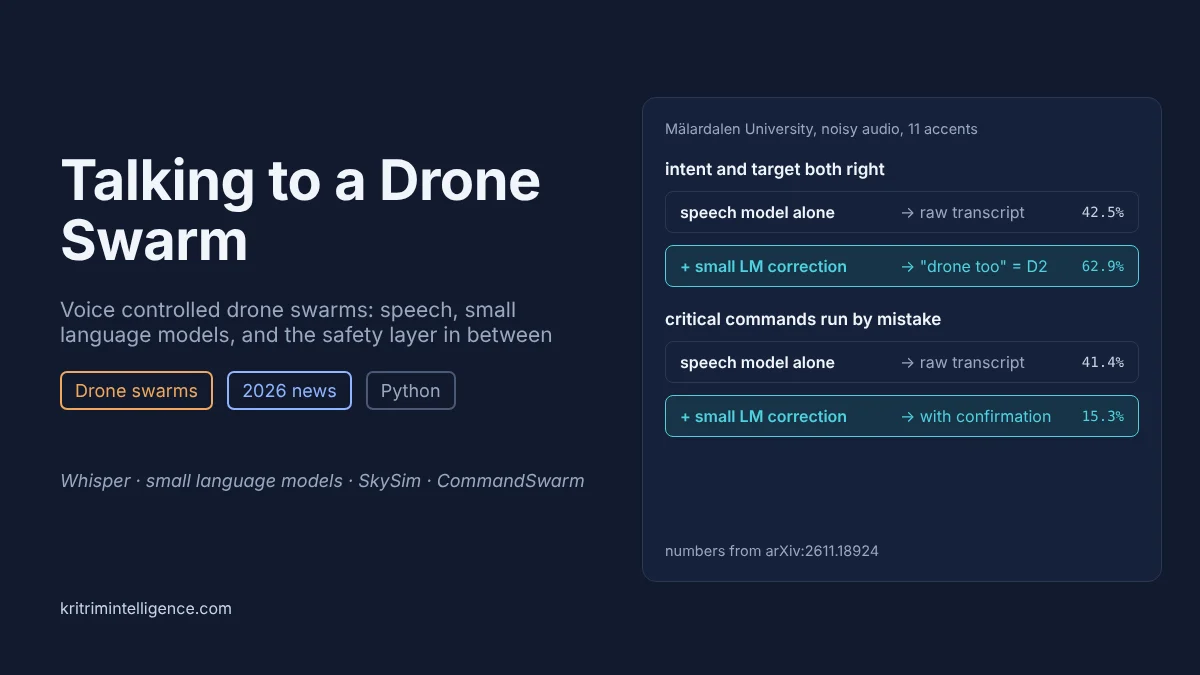
| The headline numbers | On noisy audio, a small model's correction raised correct intent and target from 42.5% to 62.9%, and cut critical commands run by mistake from 41.4% to 15.3% |
| What it still misses | No setting reached zero critical mistakes; tests used synthetic speech, not real operators |
| Our Python result | Always confirming abort, land and return home cut critical mistakes from 1.67% to 0, for 6.6 more points of operator checks |
Why talk to a swarm?
A single drone is easy to fly with a remote. A swarm is not. With ten or thirty drones, the operator stops flying and starts managing: who searches where, who films what, who comes home to change batteries. That is a job of giving orders, and speech is the fastest way people give orders.
- Hands and eyes stay free. Search and rescue teams, firefighters and farm workers often need both.
- Orders are high level. "Survey the north field" says more than any set of waypoints.
- Less training. A person who can describe a task can give it, without learning a ground station's menus.
The catch is that speech is the least reliable input a robot can get. A wrong waypoint typed on a screen is visible before it is sent. A misheard word on a windy field is not.
The six layers of a voice controlled swarm
Nearly every system in the 2026 papers follows the same chain:
| Layer | Job | Typical tool |
|---|---|---|
| 1. Speech recognition | Audio to text | Whisper |
| 2. Command parsing | Text to a structured command: intent, target, parameters | A small or large language model |
| 3. Dependability gate | Decide: run it, confirm it, or ask again | Confidence score and rules |
| 4. Task allocation | Decide which drone does what, and in what order | A mission planner |
| 5. Safety filter | Check every path for collisions, speed and a geofence | Potential fields or control barrier functions |
| 6. Flight control | Fly each drone along its path | PX4, ArduPilot or a custom controller |
The key design choice is that the language model only proposes. Layers 3 and 5 decide what actually flies. A language model that writes motor commands directly would be hard to trust; one that fills in a short, checked form is much easier. It is the same split between a slow thinker and a fast, safe executor that we saw in agentic robotics.
Speech recognition is the weak link
General speech recognition is very good at long, ordinary sentences. Swarm commands are the opposite: short, full of names and numbers, and often spoken outdoors over rotor noise. The errors are predictable once you see them:
- Numbers that sound like words: "drone too" or "drone tree" for drone two or three; "won" for one.
- Colours that sound like other words: "read" for red, "blew" for blue.
- Whole commands misheard: "Sophie" for "show feed", and the dangerous one, "report" heard as "abort".
A 2024 study from the Federal University of Goiás in Brazil compared three ways to command a small Tello drone by voice. Speech recognition followed by a language model reached 81% accuracy and took 1.23 seconds. A classifier trained to map each command straight onto a fixed set of commands reached 99% in 0.02 seconds. A fixed command set is fast and accurate, but it cannot handle a new sentence. That trade between flexibility and reliability runs through the whole field.
Dependable voice command with a small language model
The Mälardalen team, Afshin Ameri, Luiz Giacomossi, Håkan Forsberg, Ivan Tomasic and Baran Cürüklü, built the chain's first three layers with dependability as the goal, not just accuracy.
- Speech recognition: OpenAI's Whisper.
- Command parsing: a small language model, Rnj1 from Essential AI, run locally on the operator's machine. It outputs a short JSON record: intent, target, optional parameters and a confidence score from 0 to 1.
- A closed set of 13 intents: inspect, survey, suspend, abort, status, go to, land, zoom, video on, video off, altitude, return to launch and battery, plus UNKNOWN for anything unclear. Targets are known drone and team names.
- Phonetic correction: when a word does not match any valid intent or drone name, the model makes the smallest edit that does. Each correction lowers the confidence by at least 0.1. This is the same idea as TFuzzyScore: map noisy text onto a short list of names you know are valid.
- A dependability gate: run a command only when confident, ask for confirmation in a middle band, ask the operator to repeat below that, and always confirm critical commands.
To test it, they generated command sentences from a grammar, turned them into speech with 14 synthetic voices across 11 English accents, added background noise, and ran 10,000 trials. They deliberately dropped the target from 15% of commands and corrupted the intent of 5%, to see whether the gate would catch them.
The results
| Audio | Phonetic correction | Intent right | Target right | Both right |
|---|---|---|---|---|
| Noisy | No | 76.0% | 51.3% | 42.5% |
| Noisy | Yes | 84.6% | 70.4% | 62.9% |
| Clean | No | 84.8% | 57.4% | 50.6% |
| Clean | Yes | 91.5% | 75.4% | 70.5% |
Correction helped most where it was needed: targets, which are short names, and noisy audio. In noise, the gain in intent accuracy varied by voice, from 6.8 points to 15.8 points for a Jamaican English voice.
The dependability numbers matter even more:
| Condition | Critical commands run by mistake | Other wrong commands run |
|---|---|---|
| Noisy, no correction | 41.4% | 22.2% |
| Noisy, with correction | 15.3% | 15.4% |
| Clean, no correction | 32.0% | 13.4% |
| Clean, with correction | 7.4% | 8.6% |
Correction cut critical mistakes by a factor of 2.7 in noise and 4.3 in clean audio. The price was more questions: on clean audio, requests to the operator rose from 9.1% to 13.5% of commands. The authors set out to reach zero critical mistakes and say plainly that no condition did. "Abort" and "suspend" were still confused, "zoom" and "survey" were hard in noise, and all speech was synthetic, some of it hard to follow even for people.
From words to swarm behavior: SkySim and CommandSwarm
Two other 2026 papers handle the layers after the command is parsed.
SkySim, from Heriot-Watt University's Dubai campus, lets an operator say things like "form a circle". A large cloud model, Gemini 3.5 Pro, turns the request and the drones' positions into waypoints. A potential field safety filter, running 20 times a second, then nudges every path to keep drones apart, under 0.5 m/s and inside a geofence. It worked with 3, 10 and 30 simulated Crazyflie drones, and the model got every requested shape right. But planning took about 34 seconds for 3 drones and 50 for 10, with some cases over 100. The authors list small local models as future work.
CommandSwarm, from SlimX.ai, turns spoken or written commands in nine European languages into behavior trees, the structured task plans used across robotics. A safety classifier screens the command first, and a strict parser only accepts trees built from a whitelist of allowed actions. Fine tuning a 10 billion parameter model on 2,063 example pairs raised the share of valid trees with no examples in the prompt from 0% to 72%, and with two examples from 94% to 98%. The paper does not yet report whether the trees made the swarm do the right thing.
Put together, the three papers sketch the full chain: a small local model that reads speech carefully and knows when to ask, a planner that turns intent into a structured plan, and a filter that keeps every drone safe whatever the plan says.
A Python example: when should the swarm ask?
The dependability gate has one big setting: how confident must the system be before it acts? Set it low and wrong commands slip through. Set it high and the operator spends the mission saying "yes, confirm". Our simulation puts numbers on that trade.
We send 50,000 voice commands to a swarm. The speech chain reads 85% of intents correctly, about the Mälardalen result in noise. A right reading usually comes with high confidence and a wrong one with lower confidence, but the two overlap. Critical commands (abort, land, return to launch) are rare, 2% each. We compare three policies: run everything, ask the operator when confidence is below 0.6, and the same plus always confirming critical commands. When asked, the operator catches the error.
import numpy as np

# An operator speaks commands to a drone swarm in a noisy field.
# Speech recognition plus a small language model turns each one into
# (intent, target, confidence). Sometimes it gets the intent wrong:
# "report" heard as "abort" is the classic case.
INTENTS = ["INSPECT", "SURVEY", "SUSPEND", "ABORT", "STATUS", "GOTO", "LAND",
           "ZOOM", "VIDEO_ON", "VIDEO_OFF", "ALTITUDE", "RTL", "BATTERY"]
CRITICAL = {"ABORT", "LAND", "RTL"}       # commands that end or change a mission
ACCURACY = 0.85                            # share of intents read correctly (noisy field)
# in a real mission, critical commands are rare: 2% each, the rest share 94%
WEIGHTS = np.array([0.02 if i in CRITICAL else 0.94 / 10 for i in INTENTS])


def parse(true_intent, rng):
    """what the speech model hands over: an intent and a confidence k"""
    if rng.random() < ACCURACY:
        return true_intent, rng.beta(8, 2)            # right: usually confident
    wrong = rng.choice([i for i in INTENTS if i != true_intent])
    return wrong, rng.beta(4, 3)                       # wrong: less sure on average


def run(theta, confirm_critical, n, rng):
    """theta: run commands at or above this confidence, ask the operator below it"""
    catastrophic = spurious = asked = 0
    for _ in range(n):
        true = rng.choice(INTENTS, p=WEIGHTS)
        heard, k = parse(true, rng)
        if k < theta or (confirm_critical and heard in CRITICAL):
            asked += 1                                 # operator checks it and fixes errors
            continue
        if heard != true:
            if heard in CRITICAL:
                catastrophic += 1                      # e.g. the whole swarm lands mid survey
            else:
                spurious += 1                          # e.g. wrong drone starts video
    return catastrophic / n, spurious / n, asked / n


rng = np.random.default_rng(0)
N = 50000
print(f"{'policy':>38} {'catastrophic':>12} {'spurious':>9} {'asks operator':>14}")
for name, theta, conf in [("run everything", 0.0, False),
                          ("ask when confidence < 0.6", 0.6, False),
                          ("ask when < 0.6, always confirm critical", 0.6, True)]:
    c, s, a = run(theta, conf, N, rng)
    print(f"{name:>38} {c:>12.2%} {s:>9.2%} {a:>14.1%}")
Running it prints:
                                policy catastrophic  spurious  asks operator
                        run everything        3.54%    11.16%           0.0%
             ask when confidence < 0.6        1.67%     5.36%          14.2%
ask when < 0.6, always confirm critical        0.00%     5.13%          20.8%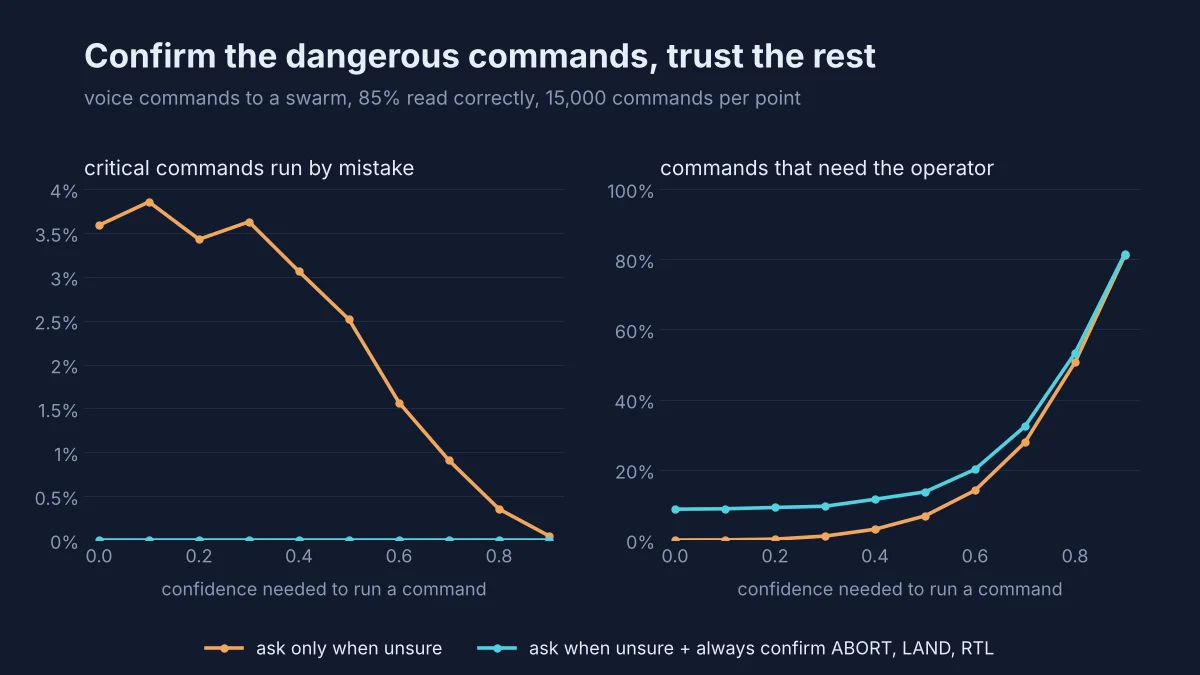
Running everything is not an option. With 85% accuracy, 3.5% of all commands become a critical mistake, such as the swarm landing in the middle of a survey. That is roughly one every 28 commands.
A confidence threshold helps, but cannot finish the job. At 0.6, critical mistakes fall to 1.7% and the operator checks 14% of commands. Pushing to 0.9 gets mistakes near zero, but the operator then checks 81% of everything. Voice control stops being useful.
Confirming critical commands is nearly free. Critical commands are rare, so always confirming them costs about 6.6 more points of operator checks at a 0.6 threshold, and removes critical mistakes entirely in our toy. The left panel's blue line stays at zero at every threshold.
What remains is the less dangerous kind. About 5% of commands are still wrong but not critical, like the wrong drone starting its video. Those are what the threshold and better speech recognition have to fight.
In our toy the operator always catches a mistake when asked, which real people do not. That is one reason the Mälardalen system, with real speech errors, did not reach zero. But the lesson carries over: decide which commands are dangerous, and treat them differently.
Open problems
- Real voices in real noise. Every result above used synthetic speech. Real operators hesitate, correct themselves and shout over rotor noise. A field dataset of real swarm commands would move the area forward.
- Speed. A second or more for speech and parsing is fine for "survey the field", not for "stop". Cloud planners taking 30 to 50 seconds are far too slow. This is the latency problem again, at mission scale.
- Context. "Go back to where you were" or "the one on the left" needs memory and a shared picture of the scene. Most systems still treat each command alone.
- Knowing who is meant. Target names were the weakest part of the Mälardalen results. Short, distinct call signs, chosen to be hard to mishear, may help as much as a better model.
- Each drone knowing where it is. A command like "survey the north field" assumes every drone has a reliable position. Indoors or with GPS jammed, that is a research problem of its own, which we covered in how drones fly without GPS.
Frequently asked questions
Can you control a drone swarm with your voice?
Yes, in research systems. Speech recognition turns the operator's words into text, a language model turns the text into a structured command such as an intent and a target drone, and a planner and a safety filter turn that into flight paths. Most published work so far is in simulation, with synthetic speech.
Why use a small language model instead of a large one for drone commands?
A small model can run on the operator's laptop or on board, with no internet link, which matters in the field. The 2026 Mälardalen University study ran its model locally and used it for one narrow job: mapping a noisy transcript onto 13 known command types and known drone names.
What is phonetic correction in voice command systems?
Speech recognition often writes a word that sounds right but is wrong, like "drone too" for "drone two" or "Sophie" for "show feed". Phonetic correction maps such words back onto the closed list of valid commands and drone names. In the Mälardalen study it raised correct intent and target on noisy audio from 42.5% to 62.9%.
How do you stop a voice controlled swarm from running the wrong command?
Give every parsed command a confidence score, run it only above a threshold, and ask the operator to confirm everything else. Always confirm critical commands such as abort, land and return home, whatever the confidence. Then pass every flight path through a safety filter that checks collisions, speed and a geofence.
Is voice control fast enough for drones?
Not for fast flying. A 2024 study measured about 1.2 seconds for speech recognition plus a language model on a Tello drone, and cloud based swarm planners in 2026 took 34 to 50 seconds per plan. Voice works best for high level orders, such as "survey the north field", while onboard controllers handle the flying.
Closing thoughts
Talking to a drone swarm is no longer science fiction, but it is not yet dependable. The 2026 work shows a clear shape for the system: a small, local language model that maps noisy speech onto a short list of valid commands and names, a gate that knows when to ask, a planner that works in structured tasks, and a safety filter that has the final say.
The weakest links are the ones people take for granted: hearing a drone's name right in the wind, and never mistaking "report" for "abort". That is where our own research on voice controlled swarms will start, building on the noisy name matching from TFuzzyScore and the onboard autonomy from Veg.
If you run the example, try making critical commands more common, or making the confidence scores less reliable, and see when confirming them stops being cheap. We would like to hear what you find.
References
- A. Ameri, L. Giacomossi, H. Forsberg, I. Tomasic and B. Cürüklü, Dependable Voice Command for Multi-UAV Swarms Using Small Language Models, November 2026. arXiv:2611.18924
- A. Shibu, M. Saleh, M. Al Musleh and N. Abdulaziz, SkySim: A ROS2-based Simulation Environment for Natural Language Control of Drone Swarms using Large Language Models, 2026. arXiv:2602.01226
- M. Majeed and A. Y. Majid, CommandSwarm: Safety-Aware Natural Language-to-Behavior-Tree Generation for Robotic Swarms, 2026. arXiv:2605.07764
- L. E. P. Simões, R. M. Silva, L. B. Rodrigues and G. R. da Silva, Evaluating Voice Command Pipelines for Drone Control: From STT and LLM to Direct Classification and Siamese Networks, 2024. arXiv:2407.08658